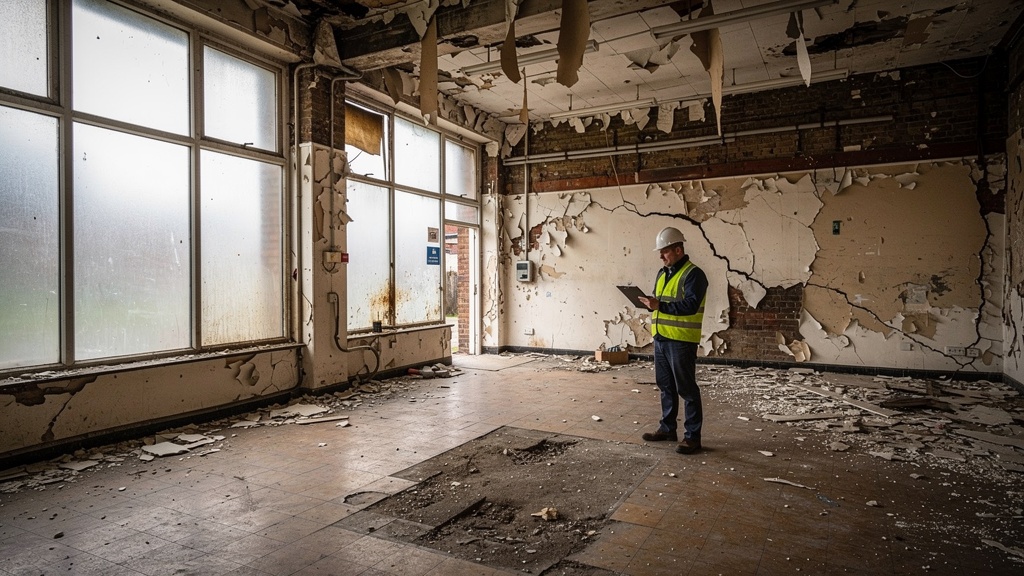
At the end of a commercial lease, dilapidations claims can be one of the most contentious and financially significant disputes a landlord or tenant will face. Understanding your obligations from day one — and instructing the right surveyor — can save you tens of thousands of pounds.
At Crowborough Surveyors, we act for both landlords and tenants on dilapidations matters across East Sussex, Kent and the wider South East.
What Are Dilapidations?
Dilapidations are breaches of a tenant's repairing and decorating obligations under a commercial lease. When a tenant vacates premises, the landlord has the right to claim compensation for any disrepair, alterations that should have been removed, or failure to reinstate the property to the condition required by the lease.
These claims can cover:
- Structural and fabric repairs (roof, walls, windows, floors)
- Internal decorations and finishes
- Removal of tenant alterations and reinstatement
- Mechanical and electrical services maintenance
- External works and car parking
The Schedule of Dilapidations
The landlord's surveyor will prepare a schedule of dilapidations — a detailed document listing every alleged breach of lease, the required remedy and an estimated cost. This forms the basis of the landlord's claim.
There are two main types:
- Interim schedule — served during the tenancy when breaches are identified
- Terminal schedule — served at or after lease expiry
The Tenant's Response: Scott Schedule
Once a schedule of dilapidations is received, the tenant's surveyor should prepare a Scott schedule — a formal response challenging any items that are disputed, not in disrepair, or excessive in the estimated costs. This is often where significant savings are made.
Common grounds for challenging a claim include:
- The item was in the same condition at the start of the lease (evidenced by a schedule of condition)
- The landlord intends to redevelop the property — so no repairs will actually be carried out
- The costs are disproportionate to the diminution in value of the landlord's interest
- The repair obligation does not extend to the item in question under the lease terms
The Importance of a Schedule of Condition
The single most important step a tenant can take is to commission a schedule of condition at the start of the lease. This photographic and written record of the property's condition at lease commencement limits the tenant's liability to the condition documented — and prevents landlords claiming for pre-existing deterioration.
Without a schedule of condition, tenants are often liable for repairing defects that existed long before they moved in. We strongly recommend every tenant instructs a qualified surveyor to prepare this document before signing any commercial lease.
The Section 18 Cap
Under Section 18 of the Landlord and Tenant Act 1927, a landlord's claim is capped at the diminution in value of their interest — i.e., the difference in the property's value with and without the disrepair. This is particularly important where the landlord intends to redevelop, as dilapidations claims may be substantially reduced.
The RICS Dilapidations Protocol
The RICS (Royal Institution of Chartered Surveyors) publishes a professional guidance note on dilapidations which sets out best practice for how claims should be conducted. Compliance with this protocol is expected of RICS-regulated surveyors and ensures a structured, proportionate approach to dispute resolution.
Key elements include:
- Early exchange of information between parties
- Without-prejudice without-costs meetings between surveyors
- Structured Scott schedule procedure
- Mediation before litigation where possible