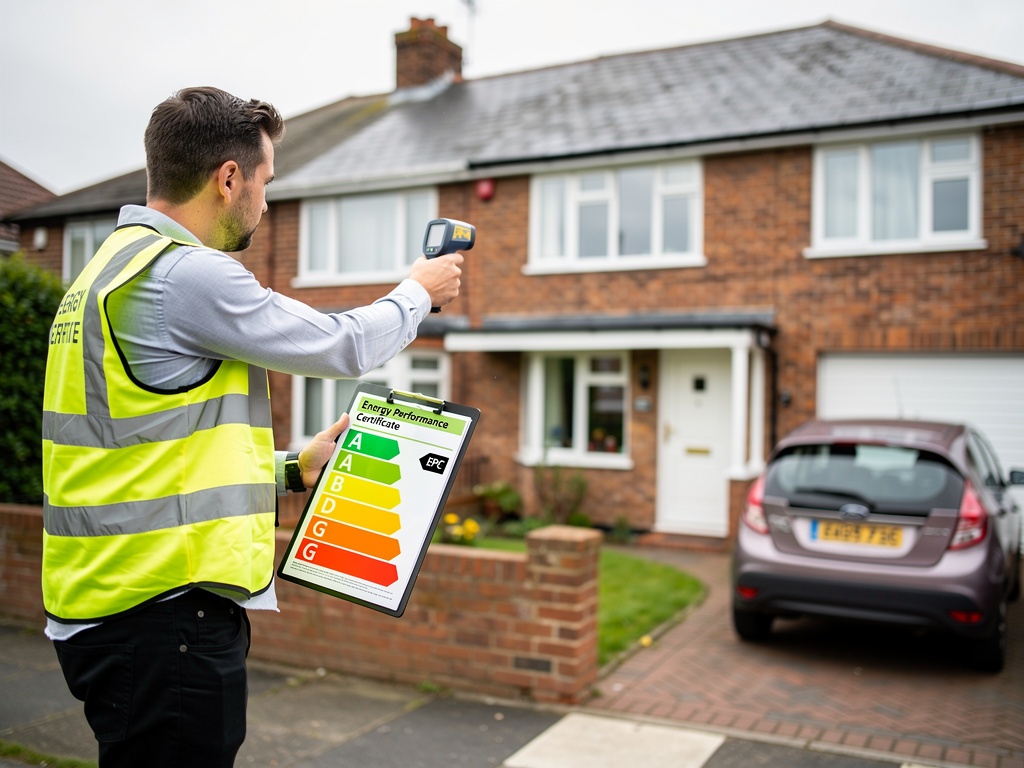
If you are buying, selling or renting a property in England and Wales, you need to understand Energy Performance Certificates. An EPC is a legal requirement for almost every residential and commercial transaction — and the rating on your certificate can significantly affect both the value and saleability of your property.
What Is an EPC?
An Energy Performance Certificate (EPC) rates a property's energy efficiency on a scale from A (most efficient) to G (least efficient). It also estimates annual energy costs and provides recommendations for improving the property's energy efficiency. EPCs are produced by accredited Domestic Energy Assessors (DEAs) and are valid for 10 years.
When Do You Need an EPC?
An EPC is legally required when you:
- Sell a property — it must be commissioned before marketing begins
- Rent out a property — a valid EPC must be provided to tenants
- Construct a new building
- Make certain energy-related improvements under government schemes
Rental properties in England must have a minimum EPC rating of E. From 2025 onwards, new tenancies will require a minimum rating of C — a change that will affect many older properties in East Sussex.
What Do the Ratings Mean?
EPC ratings run from A (most efficient, score 92–100) to G (least efficient, score 1–20). The average English home currently achieves a D rating. Most Victorian and Edwardian homes in East Sussex — with their solid walls and older heating systems — initially score E or F without improvement works.
How to Improve Your EPC Rating
Common improvements recommended in EPC reports include:
- Loft insulation — one of the cheapest and most effective improvements
- Cavity wall insulation — for properties with cavity walls (post-1920s)
- Double or triple glazing — replacing single-glazed windows
- Modern boiler — replacing old inefficient gas boilers
- Heat pump installation — air source or ground source
- Solar photovoltaic panels — particularly effective in south-facing East Sussex properties
For solid-walled Victorian and Edwardian properties, external or internal wall insulation can make a dramatic difference — but must be specified carefully to avoid trapping moisture. This is where our surveying expertise adds real value.
EPC and Property Value
Research by Rightmove and others consistently shows that properties with higher EPC ratings sell for more and sell faster. A 2023 study found that moving from an F to a C rating added around 16% to property values. With energy costs high and buyers increasingly focused on running costs, EPC ratings have never been more commercially important.
EPC for Landlords in East Sussex
With the Minimum Energy Efficiency Standards (MEES) tightening, East Sussex landlords face a significant challenge. Many older rental properties — particularly in Crowborough, Uckfield and Heathfield — currently have E, F or G ratings. Improving to a C or above before the 2025 deadline is essential. Our surveyors can advise on the most cost-effective pathway for your specific property.